
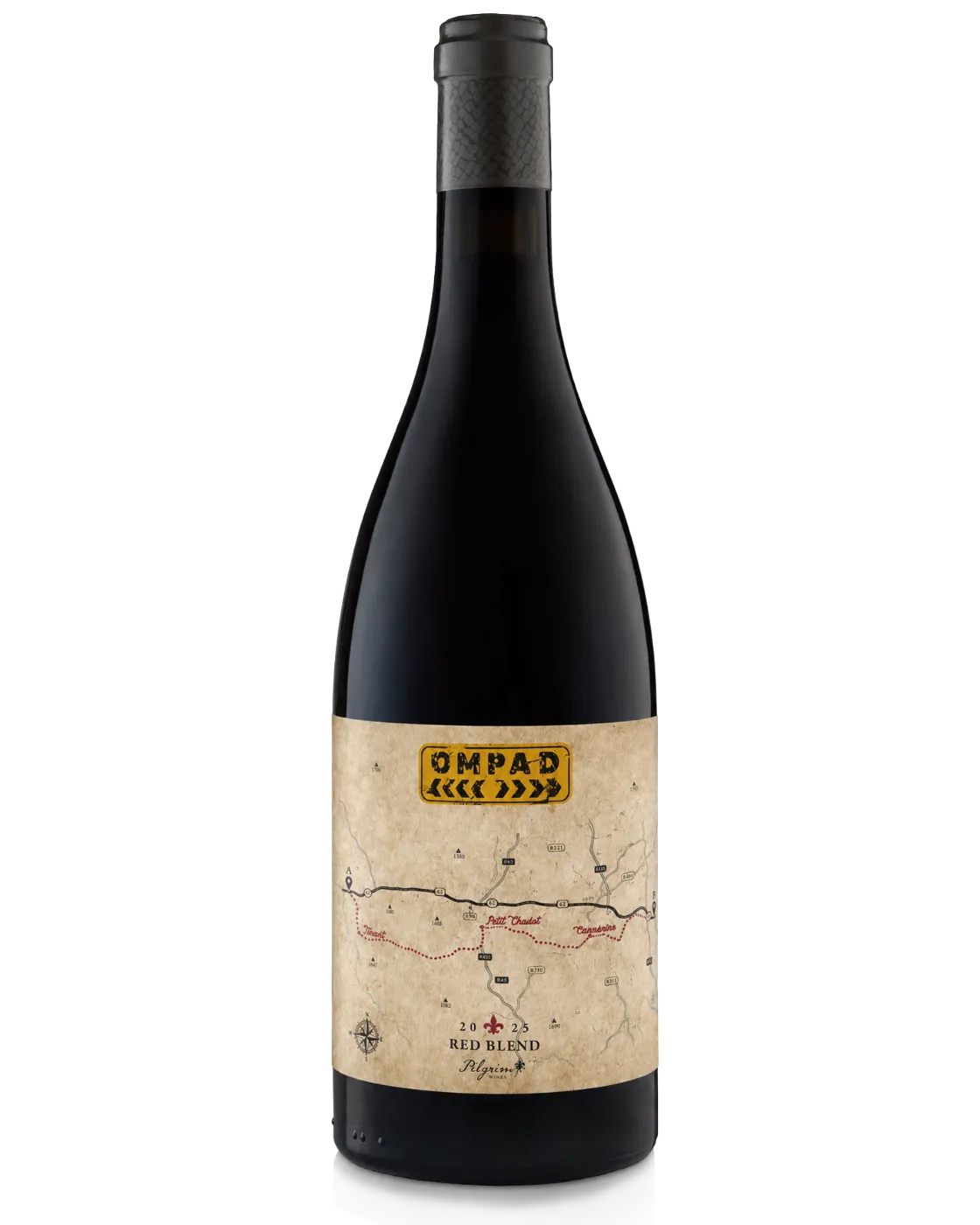
Ompad Red Blend 2025
R1,170.00 CASE OF 6
THREE INDIVIDUAL ROADS. ONE DESTINATION.
OMPAD is Afrikaans for detour: a deliberate change of direction rather than a compromise. The destination remains uncompromising quality; the route is simply less conventional. This red blend brings together Tannat, Petit Verdot and Carménère in equal parts, giving each variety the space to follow its own path through the vineyard and cellar before the three roads meet in the final wine.
Tasting Notes
For much of South Africa’s fine-wine history, the reference destination for a pedigreed red blend has been framed through Bordeaux: Cabernet Sauvignon, Merlot and Cabernet Franc, with Petit Verdot and other traditional partners in supporting roles. That model has earned its position, but a changing climate asks a broader question: can the same standards of balance, structure, ageability and site expression be reached through varieties with different ways of responding to warmer, drier and less predictable growing cycles? Consumer familiarity has often slowed that conversation. OMPAD takes the deliberate turn. Rather than imitate Bordeaux by formula, it brings Tannat, Petit Verdot and Carménère together in equal parts, allowing each to be understood and vinified on its own terms. The aim is not novelty for its own sake, but pedigree: a classically proportioned red blend whose quality is measured in the glass, reached by a route more attuned to the landscape from which it comes.
Tannat — 33⅓% The structural and colour foundation. Picked to retain an energetic red-fruited register, it contributes deep, dark layers, black cherry and plum, subtle spice and a savoury mineral edge. Its naturally firm frame is rendered polished rather than severe, bringing length, depth and authority.
Petit Verdot — 33⅓% The most overtly perfumed and spiced component, combining violet lift, dark berries and fine peppery warmth. Deep in colour yet elegant in shape, it contributes aromatic height, energy and a velvety central core.
Carménère — 33⅓% The finishing component, bringing sweet dark fruit, ripe cherry and broad, well-rounded tannin. Slightly less impenetrable in colour than Tannat and Petit Verdot, it supplies warmth, generosity and Cabernet-like architecture without an herbaceous edge.
Southern slopes of Stellenbosch Mountain All three components come from one concentrated area on the southern slopes of Stellenbosch Mountain. Red, mineral-rich decomposed granite dominates at varying depths, with smaller sandstone inclusions. Although the cultivars differ, their common origin gives the blend cohesion. In the finished wine, the site is expressed through lifted red cherry, strawberry and raspberry fruit within a darker spectrum, together with a fine mineral line and opulent, velvety tannins.
The 2025 season A delayed winter and record July rainfall led to later bud burst, while ample follow-up rain supported balanced, healthy canopies through the growing season. January was notably cooler, and Stellenbosch recorded roughly half as many days above 35 °C as the previous season. Apart from two short heat peaks in late December, ripening remained measured; the harvest itself was dry and largely free of weather interruptions. Early cultivars started around two weeks later, while mid- and late-ripening reds returned to more usual picking windows. Healthy fruit, excellent colour and pronounced varietal character created the foundation for a structured yet polished red blend.
The three varieties were harvested and vinified separately so that the best part of each could be preserved before blending. Component-led handling protected Tannat’s depth, Petit Verdot’s perfume and spice, and Carménère’s plush dark fruit and ripe tannin. Each wine matured separately in seasoned fifth-fill French oak. Once the equal-part blend was assembled, the wine returned to barrel for a further six months, completing approximately 14 months of maturation in total. The mature oak quietly polished the tannins and integrated the three components without obscuring their fruit or site expression.
Each variety followed its own road through the cellar. Only once it had established its identity did the three roads meet.
Appearance Deep garnet-ruby with a dense, dark core and a youthful crimson rim.
Nose Lifted red cherry, raspberry and ripe strawberry lead into blackberry and dark plum. Petit Verdot contributes violet perfume, pepper and warm spice; Carménère adds sweet, ripe dark fruit; and Tannat anchors the nose with graphite, savoury depth and quiet power. The seasoned oak remains discreetly in the background.
Palate Classically proportioned and Bordeaux-esque in shape, with layered dark fruit, vivid red berries and a finely drawn mineral line. Tannat supplies depth and structure; Petit Verdot brings perfume, spice and energy; Carménère rounds the centre with sweet fruit and broad, ripe tannin. The texture is the defining feature: opulent, soft and velvety, yet persistent, with sufficient freshness to keep the wine composed and precise.
Overall Three less conventional roads arrive at a familiar destination: a serious, harmonious and age-worthy Stellenbosch red blend. It is not a rejection of the classic model, but a wider view of what quality pedigree can be when variety, site and climate are considered together.
pH: 3.47
Total acidity: 5.96 g/L
Free SO₂: 26 mg/L
Total SO₂: 96 mg/L
Blend: Tannat 33⅓% | Petit Verdot 33⅓% | Carménère 33⅓%
Maturation: approximately 14 months total | Six months after blending | Seasoned fifth-fill French oak
