
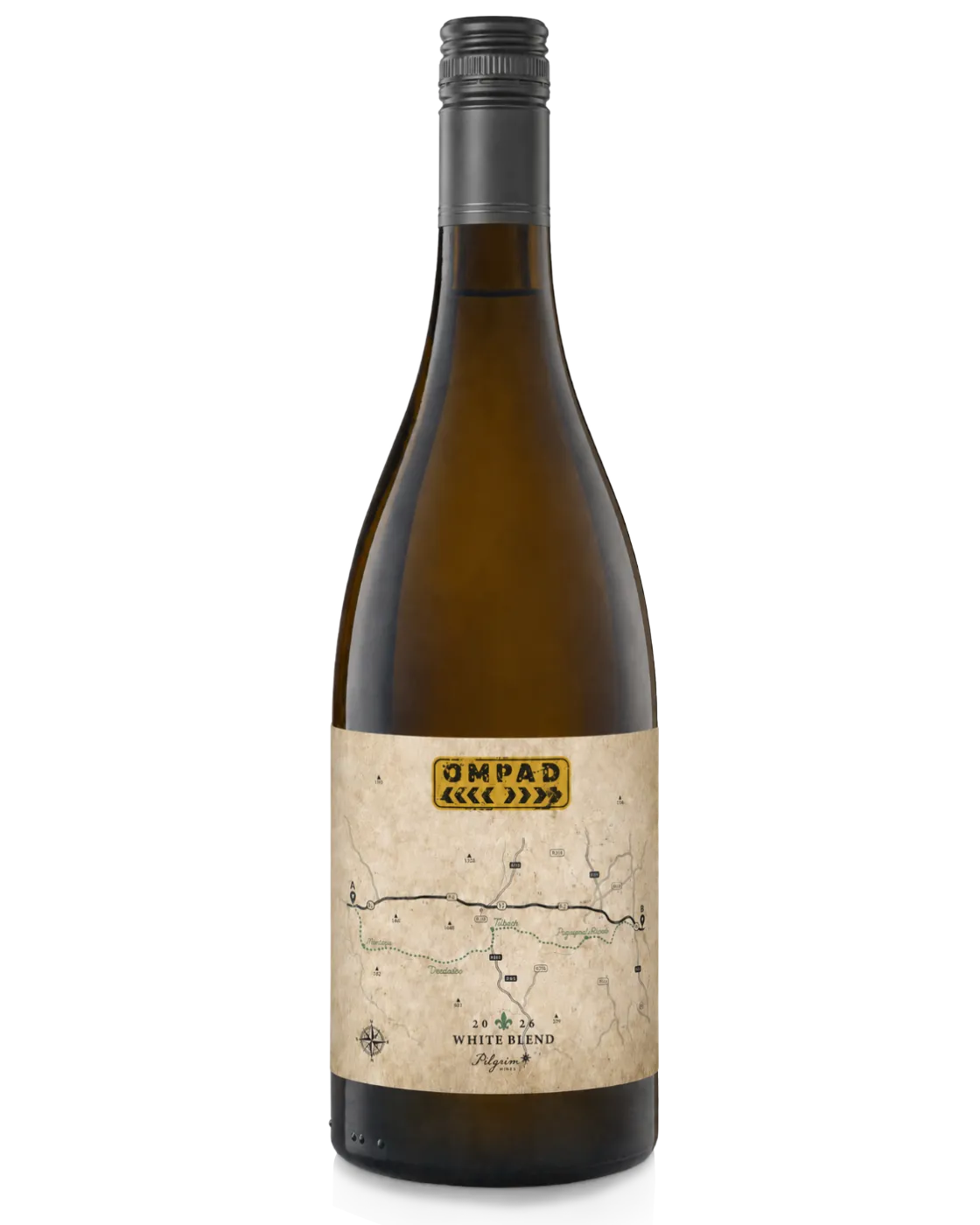
Ompad White Blend 2026
R1,010.00 CASE OF 6
FOUR INDIVIDUAL ROADS. ONE DESTINATION.
OMPAD is Afrikaans for detour: not a wrong turn or a compromise, but a deliberate change of direction. The destination remains uncompromising quality; the route is simply less conventional. This blend brings together four varieties outside South Africa’s familiar mainstream and gives each the space to follow its own path through the vineyard and cellar before the components meet in the final wine.
Tasting Notes
South Africa has an extraordinary diversity of sites and grape varieties, yet much of that potential remains unrecognised. OMPAD explores what becomes possible when unfamiliar cultivars are approached on their own terms. Albariño, Verdelho, Viura and Piquepoul Blanc share an Iberian and western Mediterranean frame of reference, but differ markedly in perfume, acidity, skin texture and phenolic character. Each component was therefore vinified separately and handled according to what it needed, rather than being forced into a single formula.
Albariño | Bottelary Hills, Stellenbosch The vineyard lies close to Mulderbosch on the granite-rich Bottelary slopes, where deeply decomposed granite provides drainage and mineral definition.
Verdelho | Voor-Paardeberg This southern Swartland site is strongly shaped by decomposed granite, with sandstone and occasional schist-derived gravel adding to the wine’s crushed-stone, graphite and mineral character. A warm, dry season accelerated ripening across the Swartland, with harvest generally beginning seven to ten days earlier than normal. The Verdelho developed concentrated perfume and breadth while preserving a firm acid line.
Viura | Goudini, Breede River Valley The Viura introduces a warmer inland expression from Goudini, where alluvial material derived largely from the surrounding Table Mountain sandstone mountains contributes a different textural signature..
Piquepoul Blanc | Kapteinskloof, Swartland Kapteinskloof lies farther west, where the deep valley and proximity to the West Coast moderate the broader Swartland heat.
Albariño | Bottelary Hills, Stellenbosch
The warm, dry start to the 2026 season encouraged early, even growth, while more moderate temperatures through January and February allowed the later-ripening fruit to develop flavour without losing freshness. The component retained naturally high acidity and a low post-fermentation pH.
Verdelho | Voor-Paardeberg A warm, dry season accelerated ripening across the Swartland, with harvest generally beginning seven to ten days earlier than normal. The Verdelho developed concentrated perfume and breadth while preserving a firm acid line.
Viura | Goudini, Breede River Valley The Breedekloof’s dry spring and summer brought moderate growth and smaller berries, followed by February rainfall and a rapid close to the season. Both early- and late-ripening white cultivars showed strong analytical and flavour development in 2026
Piquepoul Blanc | Kapteinskloof, Swartland The Piquepoul was harvested particularly early with exceptionally high natural acidity. Although it accounts for only 12% of the blend, it supplies the precise saline line, citrus energy and length that hold the wine together.
All four varieties were harvested and vinified separately. The Albariño and Verdelho received brief, carefully managed skin contact to build perfume and texture, while their thick skins and firm phenolics demanded restrained extraction. The Viura was handled even more delicately to protect its fine perfume and avoid excessive tannin or reductive character. Early-harvested Piquepoul Blanc formed the acid and mineral spine. The components matured for approximately three to four months in neutral oak barrels before blending and bottling.
Each component followed its own path through the cellar. Only once it had established its identity did the four roads meet in the final blend.
Appearance Bright and clear, with a youthful pale straw-gold colour and subtle green-gold reflections.
Nose Layered and expressive, opening with ripe pineapple, fresh apple and perfumed yellow fruit. Floral notes emerge alongside gravel, graphite and crushed stone, with a fine saline thread beneath the fruit.
Palate Bright natural acidity gives energy and precision, while carefully extracted skin texture builds breadth and gentle phenolic grip. A subtle touch of residual sweetness rounds the sharper edges and lifts the pineapple, ripe apple and tropical flavours. Albariño supplies aromatic lift and salinity; Verdelho brings perfume and volume; Viura contributes delicate fruit and balance; and Piquepoul drives the long, mineral finish.
Overall A vivid expression of alternative varieties and considered winemaking: generous in fruit, yet defined by high natural acidity, saline freshness and a gravelly mineral edge. It is the OMPAD idea expressed through wine—a familiar destination of balance, character and quality, reached by a less familiar and more revealing road.
Alcohol: 13.11%
pH: 3.21
Total acidity: 6.15 g/L
Free SO₂: 27 mg/L
Total SO₂: 96 mg/L
Stability: stable
Turbidity: 0.5 NTU
Vintage context: Vinpro Technical Harvest Report 2026.
Regional soil context: Wines of South Africa.
