
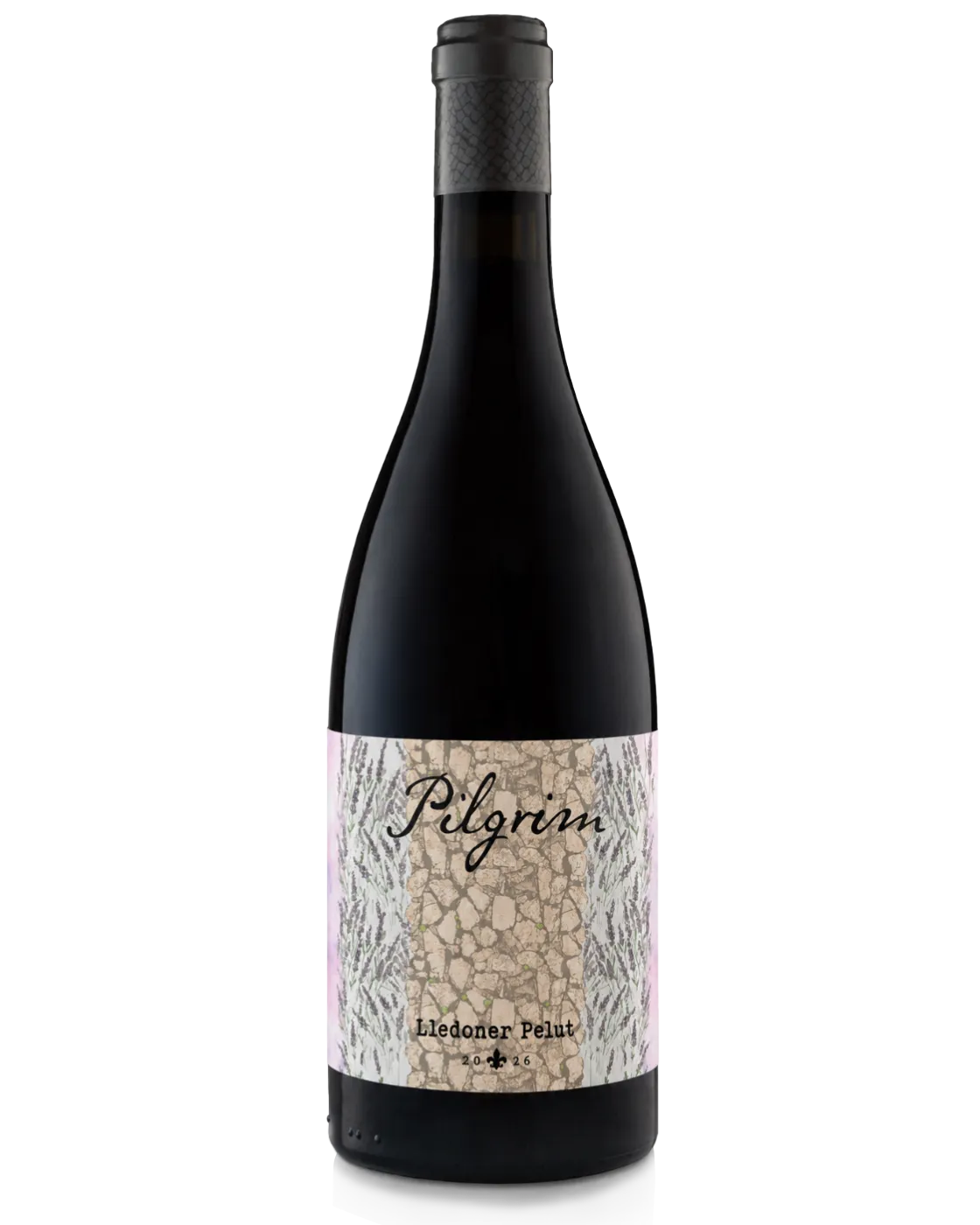
Pilgrim Wines Lledoner Pelut 2026
R1,460.00 CASE OF 6
The fruit comes from a small block in Kapteinskloof, near Piketberg in the western reaches of the Swartland. This deep, enclosed valley shelters the vines from much of the midday and late-afternoon sun, creating a distinctly cooler mesoclimate and a slower, more measured ripening season than the broader region.
Lledoner Pelut — Garnacha Peluda in Spain, and often translated as “Hairy Grenache” — is a rare natural mutation of Grenache Noir. Its name refers to the fine down on the underside of the leaves, which forms a protective boundary layer that limits transpiration and helps the vine cope with hot, dry conditions; it is also regarded as somewhat less prone to rot. Traditionally associated with Catalonia and southern France, it can reach flavour and phenolic maturity at lower sugar levels than Grenache Noir, producing paler wines with freshness and fine tannins. Its story forms part of Grenache’s medieval journey through the territories of the Crown of Aragon. In South Africa it remains exceptionally rare, with modern clean plant material first established in the Swartland in 2018.
Tasting Notes
The fruit comes from a small block in Kapteinskloof, near Piketberg in the western reaches of the Swartland. This deep, enclosed valley shelters the vines from much of the midday and late-afternoon sun, creating a distinctly cooler mesoclimate and a slower, more measured ripening season than the broader region.
Lledoner Pelut — Garnacha Peluda in Spain, and often translated as “Hairy Grenache” — is a rare natural mutation of Grenache Noir. Its name refers to the fine down on the underside of the leaves, which forms a protective boundary layer that limits transpiration and helps the vine cope with hot, dry conditions; it is also regarded as somewhat less prone to rot. Traditionally associated with Catalonia and southern France, it can reach flavour and phenolic maturity at lower sugar levels than Grenache Noir, producing paler wines with freshness and fine tannins. Its story forms part of Grenache’s medieval journey through the territories of the Crown of Aragon. In South Africa it remains exceptionally rare, with modern clean plant material first established in the Swartland in 2018.
The 2026 Swartland season followed a cold winter with excellent chill accumulation, although winter rainfall reached only around 60–70% of the long-term norm. Because the rainfall events were evenly spread, soils were replenished sufficiently and bud break was generally uniform. Warm conditions in November and December encouraged strong early growth and good fertility, while the dry season produced smaller berries and naturally concentrated flavours.
January and February were comparatively moderate, with fewer hours above 35 °C than is usual for the Swartland. Light rain and drizzle in mid-February briefly slowed the pace before a severe March heatwave accelerated the final stages of harvest. Kapteinskloof’s cool, sheltered position protected freshness and allowed flavour and spice to develop steadily. Lledoner Pelut ripened later than the Grüner Veltliner from the same site, so it remained on the vine longer and received more of the season’s later heat. As a red cultivar, it benefited from that additional warmth, reaching flavour and phenolic ripeness while retaining its natural perfume, freshness and fine-boned structure.
The grapes were harvested with the intention of preserving delicacy rather than chasing extraction or excessive ripeness. Fermentation took place on the skins for its full duration, allowing this naturally pale-coloured fruit to build a fine, complete tannic structure without losing its translucent, lighter style.
Extraction was kept gentle, drawing out red-fruit perfume, spice and the variety’s distinctive sweet herbal character. After fermentation, the wine was pressed and allowed to settle and mature in barrel without an obvious oak imprint. The result is a precise, refreshing red whose structure comes from skin contact rather than weight or alcohol. Bottled in July 2026.
Colour: Pale, luminous ruby with a translucent garnet edge — a light-coloured red whose clarity and brilliance signal its delicate style.
Nose: Perfumed and immediately intriguing. Sweet red berries, wild strawberry and ripe cherry mingle with fresh plum, crushed herbs, fynbos and cracked spice. A softly floral lift and savoury, peppery edge keep the fruit bright rather than heavy.
Palate: Fresh, vibrant and light on its feet. Raspberry, red cherry and juicy plum lead into subtle dried herbs and warm spice. The texture is supple and velvety, framed by very fine, persistent tannins and lively acidity. Its modest alcohol gives the wine an effortless, refreshing flow, while full-ferment skin contact adds shape and length.
Overall: An exciting introduction to one of the Grenache family’s lesser-known travellers: delicate in colour, generous in aroma and beautifully structured. It is a lighter red, but not a slight one — pure, spicy, finely tannic and exceptionally refreshing.
Alcohol: 11.33% Vol.
pH: 3.68
TA: 5.06 g/L
Free SO₂: 32 mg/L
Total SO₂: 83 mg/L
